
Episode 102 – Subdivision of rural land – facts and fiction
In this episode, Phil Journeaux shares his strong thoughts on the failings of the New Zealand’s National Policy Statement (NPS) for Highly Productive Land and how the Ministry for the Environment’s ‘economically viable’ metric was flawed.
Subdivision of rural land – facts and fiction
The subdivision of rural land into small/lifestyle blocks, and especially for urban use, has always been contentious. The National Policy Statement for Highly Productive Soils, is the latest attempt to control the issue. Phil Journeaux, a Consulting Agricultural Economist based in Waikato, points out that it is a castle built on sand. Words Phil Journeaux
Keep soil in its place
Heavy rain events provide an opportunity for farmers to record where water is flowing across farms and if mitigation action is needed. Words Heather Chalmers, Photos Abie Horrocks.
Smart predator control: expert advice from the field
Cam Speedy and John Bissell have spent decades helping farmers and conservation projects across the country make real headway against rats, stoats, possums, feral cats and ferrets. Words Allison Hess.
Keeping the Door Open to the EU
Silver Fern Farms, MIA and OSPRI have partnered with Prism Earth’s innovative technology to provide unprecedented insights into farmers’ natural capital that will both provide continued market access to the European Union as well as potential new revenue streams. Words Sarah Perriam-Lampp.
A biodiversity blueprint
In the gullies of Clinton in South Otago, the Campbells have developed an innovative new approach to native planting and maintenance that’s more affordable, has a higher success rate and could be scalable nationally. Words & Photos Sarah Perriam-Lampp.
The farming rulebook has changed
The recent record sale of a dairy farm in mid-Canterbury has Tom Laming reflecting on how we can take a different approach to dairy farming’s future. Words Tom Laming.
Yard weaning benefits growth rates and calf health
As calf weaning gets underway, Beef + Lamb New Zealand (B+LNZ) is encouraging farmers to consider yard weaning as a way to get calves off to a great start. Words Sandra Taylor.
Improving premiums from improving land health
From heavy lambs for Atkins Ranch, to yearling sire bulls for the dairy market, Michael and Jane Cammock at Kouratahi farm in the Wairarapa focus on added value and knowing where their end product is destined for. Words Rebecca Greaves. Photos Brad Hanson.
Rearing at scale
Strengths in the softer skills of building long term relationships, coupled with the collection of robust data, are at the heart of an impressive calf rearing operation in Canterbury that’s home to 3500 calves annually. Words Anne Lee, Photo Holly Lee.
Weaning check impacts lamb cheque
Weaning is a critical period for lamb growth rates. They can easily falter if not timed correctly. Andrew Dowling, Technical Expert – Animal Health at PGG Wrightson, offers practical solutions to help avoid a weaning check that doesn’t bounce in your back pocket. Words Sarah Perriam-Lampp.
Russian reality
Born and raised in New Zealand, Berwick Settle has just finished a year overseeing 200 people in a large dairy development in Russia.
Cropping in Canada
Born and raised in farming communities in the Waikato, Saskatchewan arable farmer, Sean Case, shares the contrast where farming liquid gold is very different.
Time to take ownership of your crops
Now back farming with Align Farms, after a 6 year stint working in agronomy roles, Will Perriam-Lampp shares his thoughts on farmers taking ownership over their crops and farm systems to avoid being sold whatever drives up their driveway.
Farming the next 50 years
After her recent overseas trips and time spent in many governance roles, such as Deer Industry NZ and Wai Wānaka, Mandy Bell, farming with her husband Jerry at Criffel Station near Wānaka, challenges our sector’s vision towards a healthy outcome.
Leave Tariffs to the Farmers
Hank Volger started ranching in 1971 in Spring Valley at the tip of Nevada, south of Las Vegas, near the Arizona border with two cows and seven sheep. His business Needmore Sheep Co has over 7,000 merino ewes shorn mostly by Kiwi shearers.
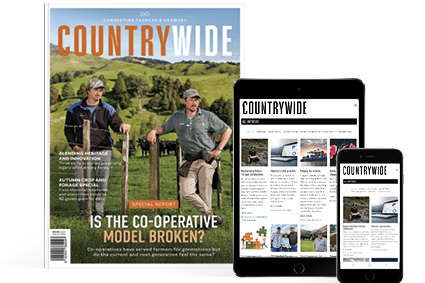
Farming is generational, co-operatives get that
LIC chair Corrigan Sowman shares his thoughts on the generational importance of co-operatives. Words Corrigan Sowman.
What does the market want?
New Zealand is renowned for producing safe, nutritious food with ethical farming practices. This special report explores how food and fashion brands are meeting changing customer demands and our farmers’ efforts to match the evolving requirements with evidence. Words Anne Lee & Sarah Perriam-Lampp.
Shed or Shear?
Kate Kellick’s Kellogg report calls for a shift towards shedding sheep as a solution to the pressing issues facing New Zealand’s sheep farming industry. Words Sarah Perriam-Lampp.
Diversification Pays the Bills
A UK YouTuber farmer with 14 different income streams shared his entrepreneurial recipe as a recent keynote speaker at the Foundation for Arable Research conference. Words Heather Chalmers.
Integrating Forestry Into Sheep & Beef Farming
How can sheep and beef farmers see forestry as more than a binary choice between farming and full conversion to pine plantations? New Zealand Institute of Forestry registered Forestry Consultant Peter Handford showcases the business case for sheep and beef operations to integrate forestry to support overall farm management and profitability. Words Peter Handford, Groundtruth.
MORE
Long-term pasture persistence trial
A 10-year Lincoln University long-term pasture persistence trial (PPT), looking at different grass species, predominantly perennial ryegrass, is unique in its duration and ability to evaluate the performance of a range of grass cultivars.Words Sarah Perriam-Lampp.
Ryegrasses can last
The next step for summer-strong perennial ryegrass that persists is now here with Maxsyn NEA12. Words Sarah Perriam-Lampp.
The true cost of cheap
After four decades working in irrigation, Stephen McNally is urging whole-of-life thinking for irrigation design. The one lesson that keeps repeating is that systems chosen on capital price alone rarely deliver the best long-term value. Words Stephen Mcnally & Kath Healy.
Farming in the age of technology: Insights from farmers
A recent farmer panel highlighted the importance of balancing the adoption of new technologies while still retaining core farming skills. Words Sarah Perriam-Lampp.
Zapping weeds in Southland
In late winter, emerging from a carrot paddock near Woodlands, the sight of bright lights, faint zapping sounds and puffs of smoke might turn a few heads; but it is just Matthew Malcolm's "killer robot" at work. Words Karen Trebilcock.